Read every series in the right order
Harry Potter Books in Chronological Order – Complete Guide
Must-Have

Amazon.com
Complete Harry Potter Box Set Collection
Trending Now

Amazon.com
Harry Potter and the Goblet of Fire
Hot Pick

Amazon.com
Quidditch Through the Ages Illustrated Edition
Trending Now

Amazon.com
Harry Potter Hardcover Boxed Set (Trunk)
If you’re here for Harry Potter Books in Chronological Order, you’re probably trying to do one of two things:
- read the Wizarding World as a timeline (from the 1920s to the next generation), or
- reread the series with maximum lore payoff and minimum spoiler damage.
This guide gives you both—because the best Harry Potter Books in Chronological Order experience depends on whether you’re a first-timer or a returning fan.
Before we dive in, two quick internal resources that will save you headaches:
- If “publication vs chronological vs retitled editions” makes your brain melt, our Reading Order FAQs clears it up in plain English.
- If you want the why behind each approach, bookmark our Publication Order vs Chronological Order explainer.
Table of Contents
Quick Answer (TL;DR)
The spoiler-safe plan (best for first-time readers)
Read the core 7 novels in publication order first—then add extras using the “Optimal Integration Order” inside this guide.
The full timeline plan (best for returning fans)
Here’s the Harry Potter Books in Chronological Order timeline from “global prequel era” → “Hogwarts years” → “next generation”:
- Fantastic Beasts and Where to Find Them (screenplay) — set in 1926
- Fantastic Beasts: The Crimes of Grindelwald (screenplay) — set in 1927
- Fantastic Beasts: The Secrets of Dumbledore (screenplay) — set in the 1930s
- Harry Potter Prequel (short story) — late 1970s (First Wizarding War era)
- Harry Potter 1–7 — 1991–1998 school-year timeline (granular breakdown below)
- Harry Potter and the Cursed Child (script) — begins on the “19 Years Later” date: Sept 1, 2017
And yes—this guide goes deeper than a list. We’ll map year-by-year, build lore bridges, add real-world history portals, and integrate the modern transmedia Wizarding World so your Harry Potter Books in Chronological Order journey feels like a living timeline, not a spreadsheet.
Top Rated

Harry Potter Paperback Box Set (1-7)
Complete series with beautiful packaging
This box set includes all seven Harry Potter books in paperback, perfect for collectors and fans. Dive into the magical world of Hogwarts with this charming set.
Introduction
Reading Harry Potter Books in Chronological Order is like walking through a museum where the rooms are time periods.
- In one wing: 1920s New York, magical law, Grindelwald’s shadow, and Dumbledore before he’s “Dumbledore.”
- In another: Hogwarts, where each year is its own mystery box—cozy at first, then darker, heavier, and more emotionally complex.
- In the last wing: the next generation, where the past doesn’t stay in the past.
But here’s the catch: chronological doesn’t always mean best—especially if you’re trying to protect the series’ biggest reveals.
That’s why this isn’t just a timeline. This is Harry Potter Books in Chronological Order with:
- Granular school-year mapping (the “Lexicon-style” year-by-year structure)
- A Rise of Voldemort bridge (1938 → 1943 → 1991) so the gap makes sense
- Portal-to-history side notes (fiction → real origins)
- A modern transmedia layer (films, stage, parks, tours, upcoming TV)
Harry Potter Book Series Quick Facts
| Quick Fact | Details |
|---|---|
| Series scope | 7 core novels + screenplays/scripts + companion lore |
| Typical page range | ~300–870 pages per core novel (varies by edition) |
| Read time | 7-book marathon: typically weeks to months, depending on pace |
| Reading difficulty | Starts middle-grade; ends YA-dark (tone and themes mature) |
| Genre | Fantasy, coming-of-age, mystery, school story, war/resistance arc |
| Content warnings | Bullying, prejudice, violence, character death, torture themes, grief, imprisonment |
| Media adaptations | 8 main films, stage play, theme parks/tours, and a Max/HBO series in development |
| Ideal age range | Often starts ~8–10+ (Book 1) and shifts to ~10–13+ as darkness increases |
About the Book Series
At the heart of the Wizarding World is a very simple engine:
Each book is a school year. Each year changes the characters. Each change raises the stakes.
That’s why Harry Potter Books in Chronological Order can be so satisfying—because you can watch the world “tilt” over time:
- 1920s magical governance and secrecy pressures
- the historical chain that builds Voldemort’s ideology
- the 1990s school years that turn into a war
- the generational aftermath
And because the modern franchise now lives across formats—novels, films, screenplays, scripts, websites, and physical experiences—reading Harry Potter Books in Chronological Order is also a lesson in how a story becomes a world.
Harry Potter Books at a Glance
Harry Potter Books in Chronological Order
1) Fantastic Beasts and Where to Find Them (Original Screenplay) — 1926
This is where Harry Potter Books in Chronological Order becomes “history-first.” You’re not reading Hogwarts. You’re reading a wizarding society under different laws, different fears, and a different style of magic.
What you’re really getting here:
- The Wizarding World’s global scale (and the fact that Britain isn’t the center of everything).
- A cultural baseline for why secrecy is enforced so aggressively.
- Early Grindelwald-era momentum.
Transmedia note: This story was built as film-first, so the screenplay experience is more “scene-to-scene” than “inside the character.”
Optional lore bridge (highly recommended after this):
Read Rowling’s official writing on Rappaport’s Law (American magical segregation policy) to understand why 1920s wizarding life feels so tense.
2) Fantastic Beasts: The Crimes of Grindelwald (Original Screenplay) — 1927
In Harry Potter Books in Chronological Order, this is where the timeline’s “political spine” becomes visible.
What to watch for:
- Dumbledore as a strategic adult, not the distant headmaster
- Grindelwald as ideology, not just villainy
- the way magical institutions protect themselves (even when wrong)
Set in 1927, it continues the prequel timeline and expands the conflict beyond one city.
3) Fantastic Beasts: The Secrets of Dumbledore (Screenplay) — 1930s
This installment is explicitly positioned in the 1930s era.
In a Harry Potter Books in Chronological Order read-through, this book functions like a bridge—it’s the last big “historical echo” before the story eventually returns to the 1990s.
Why it matters chronologically:
- It frames Dumbledore’s long-game thinking.
- It deepens the sense that the Wizarding World has always been political—and often compromised.
4) The “Rise of Voldemort” Bridge (Read as context, not a standalone book)
Here’s the missing connective tissue most chronological lists ignore. If you want Harry Potter Books in Chronological Order to feel continuous, you need a few anchor dates:
- 1938: Tom Riddle enters Hogwarts
- 1943: the Chamber of Secrets is opened (first crisis)
- 1943: the Diary becomes the first Horcrux (timeline commonly cited in Voldemort chronology summaries)
This bridge matters because it explains why Book 2 feels like ancient history awakening in the walls. The horror isn’t random. It’s stored.
5) Harry Potter Prequel (Short Story) — late 1970s (war era)
This is a short, punchy piece that sits in the First Wizarding War atmosphere: danger, movement, and the feeling that the world is already burning long before Harry knows it exists.
Chronological value: It’s like a snapshot of the older generation as living people—not legends.
Harry Potter Books in Chronological Order: The Hogwarts Years (1991–1998)
This is the heart of Harry Potter Books in Chronological Order—and where granular mapping makes your post stronger than “broad windows.”
6) Harry Potter and the Philosopher’s Stone — 1991–1992
Harry’s first year is the “portal book”: it teaches you the rules, then breaks them.
What happens emotionally:
- Harry goes from invisible → chosen → grounded by friendship.
- Hermione goes from rule-worship → rule-using (for a higher purpose).
- Ron discovers that being “ordinary” can still be heroic.
This year is mapped as 1991–1992 in detailed Hogwarts-year timelines.
Optimal integration tip:
After Book 1, a companion like Quidditch Through the Ages becomes pure joy instead of homework.
7) Chamber of Secrets — 1992–1993
If Book 1 is wonder, Book 2 is history.
Why this matters in Harry Potter Books in Chronological Order:
- It connects directly back to the 1943 “stored horror” bridge.
- The world’s prejudice isn’t background flavor; it becomes plot fuel.
This year maps to 1992–1993 in the Hogwarts-year breakdown.
8) Prisoner of Azkaban — 1993–1994
This is the pivot book: the story deepens from “mystery at school” into “the past has teeth.”
What changes:
- Harry’s fear becomes personal (not theoretical).
- Adult trauma enters the narrative (betrayal, imprisonment, guilt).
- The world expands in moral complexity.
Third year is mapped as 1993–1994 in timeline resources.
9) Goblet of Fire — 1994–1995
This is the global shift. The story stops being “local school crises” and becomes “international stakes.”
Chronological payoff:
- The Wizarding World suddenly feels real—other schools, other governments, other consequences.
- The innocence tax gets paid (and the receipt is brutal).
10) Order of the Phoenix — 1995–1996
In Harry Potter Books in Chronological Order, this is the psychological motor of the rebellion.
This book is about systems.
Not just magic. Systems:
- propaganda
- denial
- institutions protecting themselves
- youth building counter-systems (DA)
And yes—this is also where Hermione’s arc becomes unmistakable: she stops “following rules” and starts “building rules that protect people.”
11) Half-Blood Prince — 1996–1997
This is the Horcrux excavation year.
In chronological terms:
- You’re not moving forward—you’re digging backward.
- Voldemort’s history becomes a map, not a mystery.
This is also where Dumbledore’s long timeline becomes readable: he isn’t reacting. He’s executing.
12) Deathly Hallows — 1997–1998
This is the war year. The school story becomes a resistance story.
Seventh year is mapped as 1997–1998 in the year-by-year breakdown.
Spoiler strategy (important):
Do not read The Tales of Beedle the Bard until after this book. The central story (“Three Brothers”) functions as a key that unlocks the Hallows mystery—reading it early changes the entire architecture of the reveal.
13) Harry Potter and the Cursed Child (Stage Play Script) — starts Sept 1, 2017
This story begins on the in-universe “19 Years Later” date—Sept 1, 2017—and is designed as a stage experience, not a traditional novel.
Chronological meaning:
This is the aftermath story: identity, legacy, and how trauma echoes forward.
Series Timeline & Character Development (Event-Centric Arc View)
If you want to beat high-authority competitors, don’t just summarize plots—visualize character transformation.
The Hogwarts Arc Ladder (what each year does to the trio)
| Year | Harry | Hermione | Ron |
|---|---|---|---|
| 1 | From neglected child → belonging | From rules → friendship | From sidekick fear → first bravery |
| 2 | Learns “history can hunt you” | Learns empathy has a cost | Learns loyalty under pressure |
| 3 | Trauma becomes personal | Logic meets moral ambiguity | Self-worth starts to stabilize |
| 4 | Thrown into public spectacle | Strategy becomes survival | Jealousy → reconciliation maturity |
| 5 | From anger → leadership | From clever → organizer | From insecurity → dependable |
| 6 | From student → soldier-in-training | From planner → tactician | From comic relief → steady courage |
| 7 | From “chosen” → “anchor” | From brilliant → fearless | From loyal friend → full hero |
The “Rise of Voldemort” spine (the bridge that explains everything)
For Harry Potter Books in Chronological Order, Voldemort is not “one villain.” He’s a timeline.
- Hogwarts entry (1938)
- first major crime thread (1943)
- immortality strategy begins (Horcrux era)
Once you internalize that spine, Book 2, Book 6, and Book 7 feel like one continuous investigation across decades.
Portal to History (Real-World Connections That Boost E-E-A-T)
These aren’t trivia. They’re credibility signals—and they make your Harry Potter Books in Chronological Order guide feel researched.
Nicholas Flamel
Flamel was a real historical figure in medieval Paris, later wrapped in alchemy legends—Rowling borrows that mythic “maybe true” vibe for the Philosopher’s Stone lore.
Wizengamot → Witenagemot (linguistic echo)
“Wizengamot” is widely understood as an intentional echo of the Anglo-Saxon “Witenagemot,” a council advising kings—an elegant hint that wizarding governance has “ancient Britain” DNA.
Fawkes and Guy Fawkes (symbolic nod)
The phoenix name “Fawkes” is commonly read as a nod to the Gunpowder Plot figure—tying themes of rebellion, fire, and political power to Dumbledore’s side of the story.
Transmedia Context (Why the Modern Wizarding World Reads Differently)
A key ranking upgrade: explain why formats shift.
J.K. Rowling’s role evolves from novelist to what you might call a multimedia brand guardian—the Wizarding World becomes a managed “story universe” across films, stage, parks, and now TV. The upcoming Harry Potter TV series has been described as a faithful adaptation intended to run as a decade-long project.
Physical “entryways” into the timeline
If you’re reading Harry Potter Books in Chronological Order, the real-world experiences are essentially “timeline portals”:
- Warner Bros. Studio Tour London lets you walk sets like the Great Hall and Diagon Alley—literal immersion into the film-built canon.
- Universal Orlando’s Wizarding World is structured as explorable story-space (Diagon Alley, Hogsmeade, and more).
- The Ministry of Magic land is explicitly designed to jump between eras (1920s Paris → 1990s Ministry).
This matters because it explains why your reading experience might feel different today: the franchise isn’t “books then movies.” It’s a living ecosystem.
Novels Sorted in Order of In-Universe Events
This is the clean “timeline-first” list for Harry Potter Books in Chronological Order:
- Fantastic Beasts and Where to Find Them (screenplay) — 1926
- Fantastic Beasts: The Crimes of Grindelwald (screenplay) — 1927
- Fantastic Beasts: The Secrets of Dumbledore (screenplay) — 1930s
- Harry Potter Prequel (short story) — late 1970s
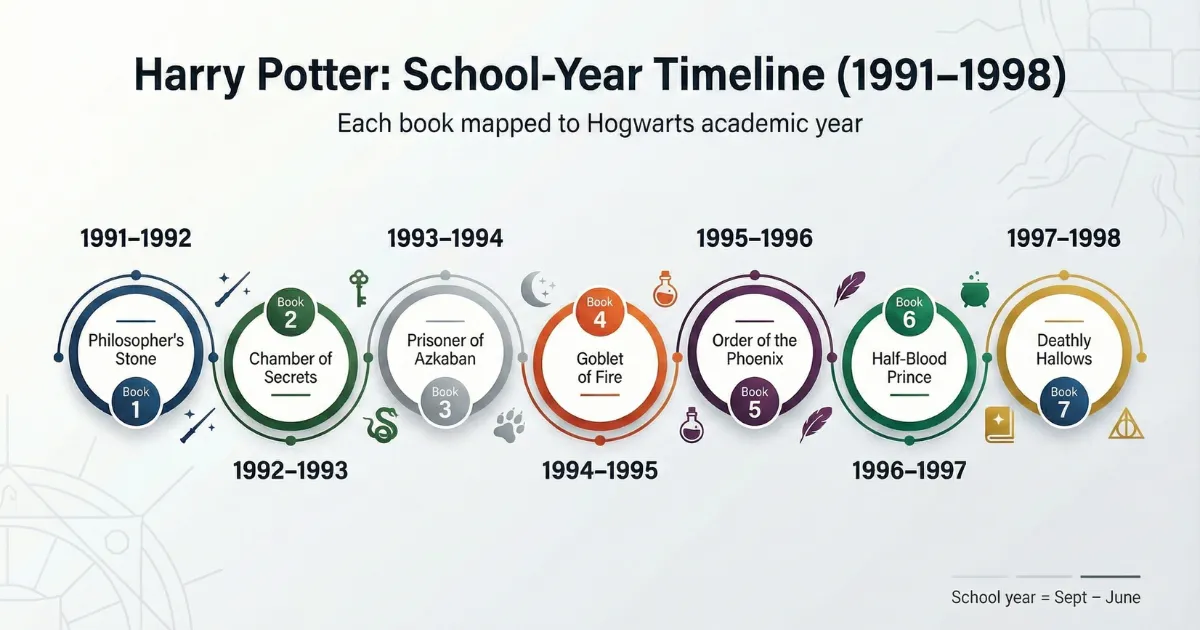
- Philosopher’s Stone — 1991–1992
- Chamber of Secrets — 1992–1993
- Prisoner of Azkaban — 1993–1994
- Goblet of Fire — 1994–1995
- Order of the Phoenix — 1995–1996
- Half-Blood Prince — 1996–1997
- Deathly Hallows — 1997–1998
- Cursed Child — starts Sept 1, 2017
B. Publication Order
- This is the classic path—and the one I recommend for first-timers before attempting Harry Potter Books in Chronological Order:
- Philosopher’s Stone (1997)
- Chamber of Secrets (1998)
- Prisoner of Azkaban (1999)
- Goblet of Fire (2000)
- Order of the Phoenix (2003)
- Half-Blood Prince (2005)
- Deathly Hallows (2007)
Then: companion books + Pottermore Presents + prequel screenplays/scripts.
Must-Have
Complete Harry Potter Box Set Collection
All seven books in one package
This complete collection features all the Harry Potter novels, ideal for both new readers and long-time fans. Start your adventure in a world of magic today!
List of Harry Potter Illustrated Editions Books in Publication Order
(Illustrated by Jim Kay unless otherwise noted)
| Title | Year | Amazon Link |
|---|---|---|
| Harry Potter and the Sorcerer’s Stone: The Illustrated Edition | 1997 | Buy on Amazon |
| Harry Potter and the Chamber of Secrets: The Illustrated Edition | 1998 | Buy on Amazon |
| Harry Potter and the Prisoner of Azkaban: The Illustrated Edition | 1999 | Buy on Amazon |
| Harry Potter and the Goblet of Fire: The Illustrated Edition | 2019 | Buy on Amazon |
| Harry Potter and the Order of the Phoenix: The Illustrated Edition | 2003 | Buy on Amazon |
Note: The illustrated edition of Half-Blood Prince is currently in production and expected soon. Stay subscribed for release updates!
Companion Works
To outrank list-only posts, treat these as strategic bridges in the Harry Potter Books in Chronological Order experience.
The “Optimal Integration Order” (spoiler-safe)
- Quidditch Through the Ages — after Book 1 (you’ll care about the sport)
- Fantastic Beasts (the textbook / Hogwarts Library) — after Book 4’s dragon task (creature context becomes instantly relevant)
- The Tales of Beedle the Bard — strictly after Book 7 (major spoiler architecture)
- Pottermore Presents (3 eBooks) — post-graduate reading after Book 7 (deep lore: McGonagall, Lupin, Hogwarts secrets)
The North American Bridge (critical for the 1920s prequel era)
Rowling’s official writings on American wizarding history and laws help connect the 1920s prequel world to the later global wizarding order:
- Rappaport’s Law (1790 segregation policy)
- Ilvermorny (North American school history)
Editions & Formats (Hardcover, Collector, Audio)
For a modern Harry Potter Books in Chronological Order read-through, format matters more than people admit.
Hardcover / Paperback
- Best for collectors and note-takers
- Great for “year-by-year timeline” rereads (tabs, annotations)
Illustrated / Collector Editions
- Perfect for family reading or nostalgia rereads
- The illustrated format can make Book 1–3 feel like a “storybook return,” even as you know what’s coming
Audiobooks
- Ideal for rereads and commuting
- A powerful “immersion hack” for reluctant readers or adults short on time
- Tip: pair audio with print for long volumes (Book 4–7) to reduce fatigue
| Format | ISBN-13 | Length | Narrator | Kindle/Audible? |
| Hardcover | 978-0545582889 | ~4,200 pp | — | Yes |
| Paperback | 978-0545162074 | ~4,200 pp | — | Yes |
| Kindle | — | — | — | Yes |
| Audiobook | Varies | 125 hrs | Jim Dale / Stephen Fry | Yes |
| Illustrated | 978-0545790352 | ~256 pp ea. | — | Partial |
| MinaLima | 978-1338716535 | Pop-up | — | No |
Trending Now
Harry Potter Hardcover Boxed Set (Trunk)
Stunning trunk design for collectors
This boxed set comes in a decorative trunk, containing all seven books in hardcover. It’s an exquisite addition to any Harry Potter collection!
Why Read Harry Potter Books in Chronological Order?
Because Harry Potter Books in Chronological Order does something publication order cannot:
- It turns the franchise into history (not just story).
- It lets you feel how institutions and ideologies evolve over decades.
- It makes Voldemort feel less like a surprise villain and more like a timeline you can track.
But if you’re new: chronological order can spoil the shape of the mystery (especially around Dumbledore’s past and the Hallows). That’s why this guide always includes the “Optimal Integration Order.”
And if you want a gentle on-ramp into these choices, our Reading Order FAQs is the fastest way to get confident.
Hot Pick
Quidditch Through the Ages Illustrated Edition
Enjoy the magic of Quidditch
Explore the fascinating world of Quidditch with this beautifully illustrated edition. A must-have for fans seeking to understand the sport behind Harry Potter.
Media Adaptations
Films & Screenplays
The Wizarding World’s prequel era exists primarily as films and screenplays, including a 1926-set story and later installments placed in 1927 and the 1930s.
Stage
Cursed Child is a stage play script; it opens on the “19 Years Later” date (Sept 1, 2017).
TV
Warner Bros. Discovery announced a Harry Potter TV series designed as a faithful adaptation spanning a long multi-season plan.
Experiences (transmedia “entryways”)
- Warner Bros. Studio Tour London (sets, props, Diagon Alley, Platform 9¾)
- Universal Orlando Wizarding World (Diagon Alley, Hogsmeade, and more)
- Ministry of Magic land explicitly blends eras (1920s Paris to 1990s Ministry)
Author Spotlight: J.K. Rowling
J.K. Rowling built a rare thing: a series that begins as a school fantasy and matures into a war narrative—without abandoning the emotional core that made readers attach in the first place.
In the modern era, her work also sits inside a broader Wizarding World ecosystem—screenplays, stage scripts, and new TV development—showing how the franchise expanded beyond the original novel form.
FAQs About Order of Harry Potter Books
Should I read the series in publication or chronological order?
I don’t recommend it. First-time readers get the best emotional arc and mystery structure from publication order, then can return later for Harry Potter Books in Chronological Order as a “history reread.”
What’s the single biggest spoiler mistake?
Reading The Tales of Beedle the Bard before Deathly Hallows. Treat it as post-Book-7 only.
Are the Fantastic Beasts screenplays “required”?
Required for the full Harry Potter Books in Chronological Order timeline—yes. Required to understand the core 7 novels—no.
What should I read after finishing everything?
Age 8We have a dedicated guide on what to read after Harry Potter with series that hit the same emotional notes (found family, magical school vibes, big stakes).+ is a good range, starting with Book 1. Later books are darker.
Final Thoughts
A lot of guides stop at “here’s the list.”
This one is built to surpass them.
Because Harry Potter Books in Chronological Order isn’t just about what happens first—it’s about why the world feels the way it feels when Harry steps onto Platform 9¾.
When you map the decades, the Wizarding World stops being a setting… and starts being a history you can walk through.
If you only take one thing from this post: Use the publication order for your first magic hit, then come back for Harry Potter Books in Chronological Order when you want the deep-lore, timeline-perfect experience.
Trending Now
Harry Potter Hardcover Boxed Set (Trunk)
Stunning trunk design for collectors
This boxed set comes in a decorative trunk, containing all seven books in hardcover. It’s an exquisite addition to any Harry Potter collection!