Read every series in the right order
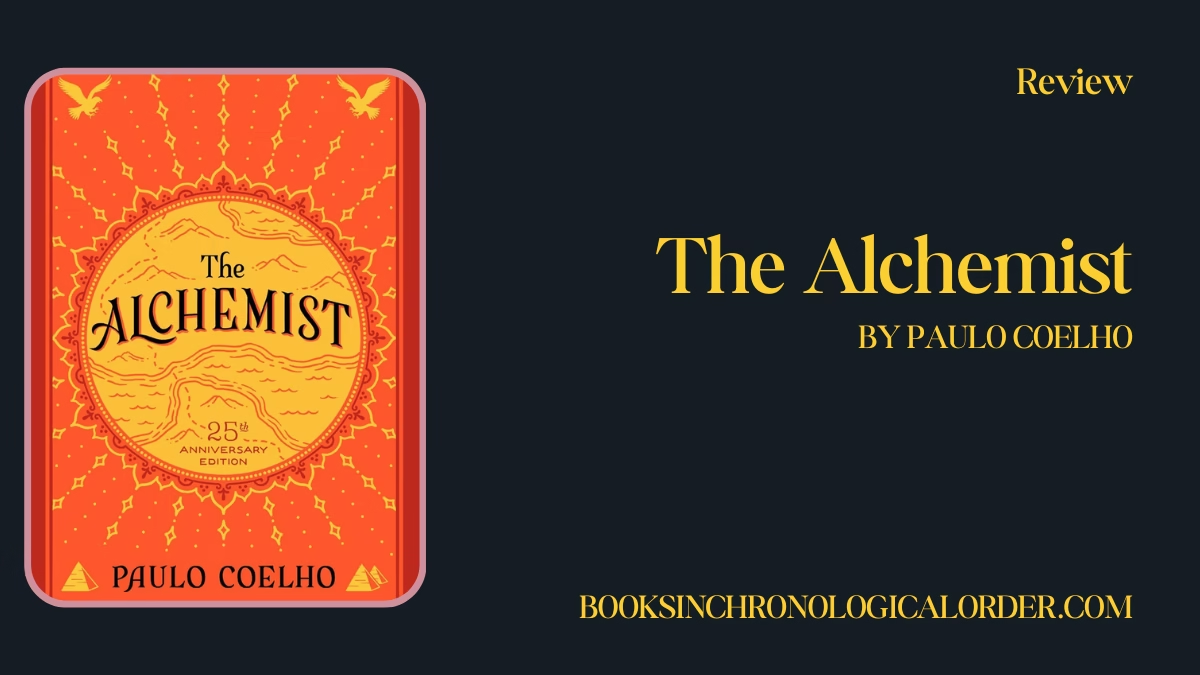
The Alchemist by Paulo Coelho — A Personal Review on Listening to Your Heart (and Doing Something About It)
What is your Personal Legend—and what’s the smallest next step you can take this week?
I didn’t expect a 170-ish page fable to pick a lock inside my chest. I thought I knew The Alchemist already—by reputation, by quotes that orbit social media, by secondhand summaries from friends who swear it “changed everything.” And yet, reading it properly (not skimming a souvenir of it), I understood why so many people—from Oprah to Neil Patrick Harris, from Pharrell to Mel Robbins—keep pressing this slim book into other people’s hands. It’s not the plot that does it. It’s the way the story dares you to sit with your own wanting.
The plot, on paper, is disarmingly simple. Santiago, an Andalusian shepherd boy, dreams of treasure buried near the Egyptian pyramids. A gypsy interprets the dream; an enigmatic king prods him toward his “Personal Legend”; a string of detours and mentors reroute his path—crystal-shop lessons, a caravan crossing the desert, an Englishman chasing the Great Work, an oasis and a love named Fatima, and finally an Alchemist who is less wizard than stern spiritual coach. Santiago’s external goal is gold. His truer goal is clarity. The treasure, as every reader half exasperated with parables will guess, is not only a chest.
If you’ve ever rolled your eyes at “the universe conspires” meme-ery, you may also have the exact temperament this book works best on: skeptical, then disarmed. Coelho writes with proverbs and parable logic—short sentences, softly turned revelations—but he doesn’t coddle. The book keeps asking a single impolite question: what would happen if you took your desire seriously enough to re-arrange your life?
I read it in two sittings, underlining less for quotability and more for permission. Not permission to be reckless. Permission to act like my life was mine.
Table of Contents
Why The Alchemist
1) It’s a short book with a long afterglow.
Call it a fable, a parable, a spiritual novella—whatever the label, the structure is compact by design. That economy is not minimalism for minimalism’s sake; it’s the kind of clarity you get when a story has been boiled down until only signal remains. You can read it in an evening. You’ll hear it for weeks.
2) It refuses to confuse complexity with depth.
I love dense, maximalist novels. I also know that complexity can be a disguise for evasion. The Alchemist makes the opposite bet. Its depth is in its directness: “What do you want?” “What are you afraid of?” “What would you trade?” It’s astonishing how radical those questions feel when a story refuses to let you dodge.
3) It gives you a spiritual vocabulary without requiring a passport.
“Personal Legend,” “omens,” the “Soul of the World”—these could slide into the vague if the book didn’t anchor them in work. The crystal shop scenes, for instance, are not airy metaphysics. They’re labor. Discipline. Choice. And they’re placed early enough in the journey to remind you that momentum is made, not manifested.
4) It’s kind to beginners and challengers.
If you thrive on self-help, you’ll find a story that feels like a mythic origin of your favorite ideas. If you worry about sentimentality, the book gives you critique points too: we’ll talk about fortune vs. responsibility, and how love does (and doesn’t) bend to destiny. It’s rare to find a novel that invites both surrender and scrutiny.
5) It’s built for re-reading at different life stages.
The first time through, you read for the treasure. The second time, you read for the shepherd. Ten years later, you notice the merchant, the Englishman, the Alchemist—the ways we each face the same test with different stories about why we can’t.
Themes That Stuck With Me
1) Personal Legend (and the Ethics of Wanting)
It’s easy to treat “Personal Legend” as a marketing slogan for dreams. Coelho doesn’t. The book insists that a calling isn’t a daydream you admire from a distance; it’s an obligation you step toward, knowing you’ll be clumsy at first and lonely sometimes. The king (Melchizedek) frames this not as entitlement but accountability: if you have a thing that won’t stop tugging your sleeve, ignoring it is its own kind of lie.
What struck me on this reading is how the novel links desire to duty. Santiago’s choices keep costing him—flocks, money, comfort, assumptions. A dream you won’t pay for is a hobby. A “legend” you won’t be inconvenienced by is a story about someone else.
My margin note: Wanting is not childish. It’s expensive.
2) Omens and the Skill of Attention
“Omens” are not mystical Easter eggs for the clever; they’re what the world looks like when you’re paying terrified attention. The hawks over the oasis, the broken crystal, the recurring dream—each is invitations to act. What matters isn’t divination. It’s noticing and then making a move. Reading omens becomes a discipline: aligning to the present so closely that you can tell the difference between fear and warning.
The book also respects how easily we can talk ourselves out of attention. The crystal merchant wants to go to Mecca and doesn’t. The Englishman wants the right books to do his living for him. Both deserve compassion. They also give the novel its gravitational pull: every time Santiago meets a person who has rehearsed a life more than he has lived it, the book quietly asks, “Are you rehearsing too?”
My margin note: An omen is only as potent as the decision it provokes.
3) Fear, Failure, and the Price of Admission
The most practical line in the book (for me) is that a dream’s most reliable assassin is not failure but the fear of losing what you’ve already gained. When Santiago contemplates staying at the crystal shop—steady money, predictable days—he’s facing the fear every adult recognizes. Stability is a virtue. It is also, often, a misnamed stall.
Coelho doesn’t demonize security. He reminds you that “secure” can become a story that shrinks you until you fit it. The antidote isn’t recklessness; it’s remembering that failure is tuition, not indictment. Each setback—robbed in Tangier, wandering the desert, misreading a sign—becomes another rung on the ladder you can only see while climbing it.
My margin note: Fear is the tax we pay to keep growing.
4) Love: Not a Detour, a Direction
The oasis love story is where some readers bail, accusing the book of fairy dust. I get it. I also think the chapters with Fatima are where Coelho plays his hardest card: a love that supports a calling is more honest—and more rare—than a love that asks you to quit the journey in its name.
Fatima’s promise to wait is not passivity; it’s an ethic. The novel argues that love which requires you to abandon yourself isn’t love. Love that enlarges your life to contain the journey (and the waiting) is love worth bearing. That’s neither Hollywood nor Hallmark. That’s work.
My margin note: “If it’s love, it will not make you smaller.”
5) Alchemy as Metaphor: The Great Work Is You
Lead to gold is the metaphor; transformation is the project. The Alchemist’s lessons are blunt: “You will only learn through action.” “You must understand the language of the world by experiencing it.” The desert’s trial—finding the wind inside yourself—isn’t a CGI stunt. It’s a ritual of proving to yourself that you’re not a bystander in your own life.
There’s also a quieter alchemy running parallel to the theatrics: the conversion of fear to attention, of habit to intention, of accident to meaning. The Englishman’s shelves of books aren’t wrong; they’re incomplete. Knowledge that never risks a result becomes a moat around your life. Santiago’s learning is sweaty: bargaining, breaking, building, listening, walking. The gold at the end is nice. The man who can now hold it without mistaking it for his identity is the point.
My margin note: The “Great Work” starts whenever you do.
6) Providence, Pragmatism, and the “Universe Conspires” Line
“The universe conspires” is the most quoted (and most mocked) idea in the book. Here’s how I hear it now: when you fully commit, your world reshapes in ways that are sometimes coincidental, sometimes causal, and often invisible until you look back. You notice helpers because you’re looking for them. You spot tiny openings because you’ve trained your gaze away from giant excuses.
There’s nothing mystical about working toward a goal so clearly that other people can recognize how to help you. There’s also a little bit mystical about how help arrives exactly when your pride is soft enough to accept it.
My margin note: Conspiracy ≠ guarantee. It’s permission to collaborate with reality.
7) Simplicity and the Risk of Platitude
Let’s say the quiet thing: not everyone will vibe with The Alchemist. Some will find its lessons familiar, its parable plot predictable, its aphorisms too Instagrammable for their taste. I understand that critique and, in places, share it. I also think simplicity is risky in the best way—it leaves less grammar to hide in. When a line lands (“The secret of life, though, is to fall seven times and to get up eight”), your options are limited: apply it, or reject it. The book’s power is not that it says something brand new; it’s that it dares you to stop pretending you’ve never heard it.
My margin note: The mirror works whether or not you like the frame.
8) Work, Craft, and the Crystal Shop Gospel
Those middle chapters in the crystal shop may be the most quietly useful in the novel. Santiago doesn’t manifest; he merchandises. He repositions, experiments, cleans glass until it shines, and helps a stagnant business double because he bothers to imagine that tea tastes better in a cup that catches the light. This isn’t a TED Talk bolted onto a fable. It’s a reminder that the “universe conspiring” often looks like you giving a damn at 9:40 a.m. on a Wednesday.
My margin note: Your calling will frequently dress up as your day job and dare you to care.
9) Teachers and Thresholds
The king, the crystal merchant, the Englishman, the Alchemist—each mentor speaks a dialect of truth calibrated to where Santiago is. The king un-sticks him. The merchant humbles him. The Englishman flatters his intellect then exposes its limits. The Alchemist slams the door on excuses. It’s tempting to rank them. The novel resists. Each teacher is a threshold; each threshold asks a different price. If you read this as a self-help parable, the obvious takeaway is: change teachers as you change. Your first coach isn’t your last. The person who got you moving is not obligated to carry you across the finish.
My margin note: Outgrowing a teacher isn’t betrayal. It’s proof of the lesson.
10) The Ending (No Spoilers) and the Joke the Book Tells on You
Those who know, know: The Alchemist circles back. The destination is not where you thought, but it is absolutely where it had to be. Some readers feel cheated by that loop. I felt seen. The joke the book tells is merciful: you left home to find home. All that walking wasn’t wasted. The act of leaving made the place you began legible.
My margin note: Treasure = truth + timing + the person you became on the way.
My Final Thoughts
I’ve been around enough “transformational” content to distrust the genre. The Alchemist still got me. Not because it slipped me something sugary, but because it asserted—with disarming sincerity—that grownups are allowed to want things, and that wanting is supposed to change your behavior.
Does the book dodge some mess? Absolutely. In the real world, visas, money, illness, caretaking, and injustice complicate the momentum of any Personal Legend. Coelho’s parable is not a policy paper. It’s a story-shaped tool. The test of any tool is whether it helps you do real work. This one made me write an email I’d been postponing, say no to a project that didn’t fit, and plan a small, practical next step on a big, embarrassing dream. That’s not magic. That’s literature doing its job.
If you are allergic to earnestness, you may need a chaser—say, reread The Little Prince or Siddhartha and remind yourself that sincerity predates hashtags. If you crave permission to begin (or begin again), this is as good a green light as we get.
I closed the book grateful—not for a fantasy that rescued me, but for a fable that made me put the chair back under my own feet. And I’ll probably reread it in five years, just to see which sentences have been waiting for the next version of me.
The Alchemist by Paulo Coelho

Read This If You…
- …feel an old dream circling and want language that stiffens your spine instead of your excuses.
- …prefer parables and clean sentences over labyrinthine subplots.
- …are deciding between staying “safe” and taking a bounded risk.
- …enjoy spiritual fiction that honors effort as much as faith.
- …want a book-club pick that provokes testimony and pushback in equal measure.
- …like audiobooks: Jeremy Irons’s narration adds gravitas without syrup.
Comparison Chart With Similar Reads
| Title & Author | Why You’ll Like It After The Alchemist | Overlapping Themes | Vibe / Reading Feel | Ideal Next Step |
|---|---|---|---|---|
| Siddhartha — Hermann Hesse | A seeker’s journey toward enlightenment through renunciation, desire, and river wisdom. | Pilgrimage, inner voice, cyclical learning | Meditative, spare, luminous | Read when you want stillness with your searching. |
| The Little Prince — Antoine de Saint-Exupéry | Parable of seeing with the heart; tender wisdom in simple scenes. | Childlike vision, essential vs. superficial, love | Gentle, poetic, bittersweet | Pair for a two-hour double feature on meaning. |
| The Prophet — Kahlil Gibran | Spiritual essays on work, love, joy, sorrow—lyric aphorisms that echo. | Work as love made visible, destiny, simplicity | Hymnal, quotable, ceremonial | Dip in between chapters of big novels. |
| Jonathan Livingston Seagull — Richard Bach | Fable of a gull who pushes limits and learns mastery through practice. | Calling, discipline, transcendence | Inspirational, airy, concise | Read when you need “do the reps” energy. |
| Life of Pi — Yann Martel | Survival story that doubles as a meditation on faith and storytelling. | Belief vs. reason, fate, meaning-making | Lush, suspenseful, philosophical | For readers craving a bigger canvas with teeth. |
| The Celestine Prophecy — James Redfield | Adventure + spiritual insights structured as “lessons.” | Synchronicity, energy, intuition | New-Agey, quest-driven | If you like explicit “insights” spelled out. |
| Man’s Search for Meaning — Viktor E. Frankl | Psychologist’s memoir and logotherapy; meaning as survival. | Purpose, responsibility, choosing attitude | Sober, humane, essential | For grounding inspiration in lived reality. |