Read every series in the right order
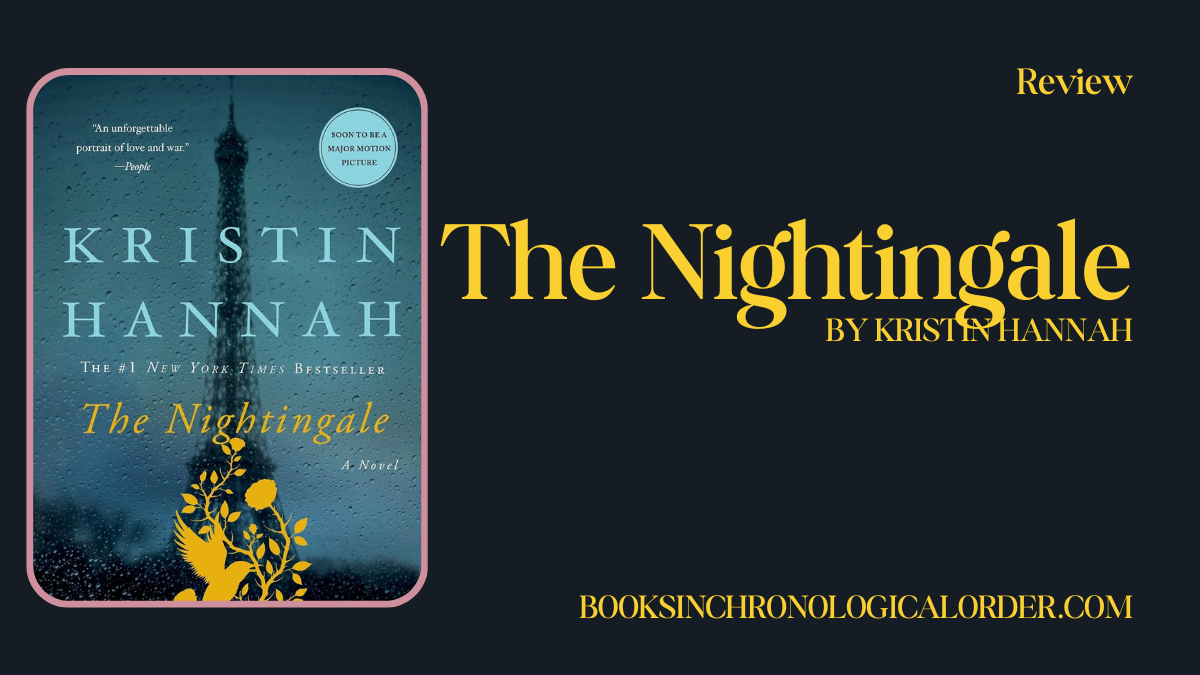
Why The Nightingale by Kristin Hannah Still Wrecks Me
Must-Have

Amazon.com
The Things We Cannot Say Novel
Top Rated

Amazon.com
Wake: Women-Led Slave Revolts
Kristin Hannah’s The Nightingale is the kind of WWII novel that sweeps you along on sheer feeling: short chapters, high stakes, and a laser focus on two very different sisters trying to stay human when their world is anything but. It’s undeniably engaging and devastating, with set pieces that will wring you out. The trade-off? The prose leans familiar (you’ll spot the clichés), and some turns feel convenient—tension sometimes softens because success arrives right when it must.
Verdict: A gut-punch of historical fiction—emotionally immersive, thematically rich, occasionally heavy-handed in the writing. If you read for feeling and moral complexity, it delivers in spades. If you crave ultra-nuanced prose and messy failures, temper expectations.
Quick hits
- Genre: WWII historical fiction (occupied France)
- Pace: Fast; bite-size chapters keep you turning pages
- Perspective: Dual sister arcs + a present-day frame
- Best for: Readers who want big emotions, moral choices, and women-centered wartime stories
- Content notes: War crimes, violence, executions, starvation, sexual assault, grief, trauma
Table of Contents
Why The Nightingale
Because it puts women’s courage front and center without shrinking from cost. Vianne and Isabelle respond to occupation in starkly different ways—one protecting home and child under a Nazi officer’s roof, the other risking everything in resistance work. That contrast gives the novel its electricity: quiet endurance vs. visible defiance.
Hannah also casts a wide net of occupied-France realities—rationing, betrayals, Jewish roundups, forged papers, clandestine routes across the Pyrenees. Even when the plotting feels orchestral (nearly every wartime cruelty and choice appears somewhere), the emotional throughline is unmistakable. You feel why ordinary people did extraordinary, dangerous, sometimes terrible things to survive or to save others.
What may not work for every reader:
- Prose & craft: Frequent clichés, repetitive sentence rhythms, and a tendency to tell you how to feel.
- Character friction: The sisters can read “larger-than-life,” succeeding at near-impossible tasks with limited stumble, which can reduce nail-biting suspense.
And yet, the book connects, powerfully. Many readers finish in tears, some calling it an all-time favorite—not because the sentences sparkle, but because the moral stakes and emotional payoffs land.
Themes That Stuck With Me
- The many shapes of bravery. Heroism isn’t a single pose. The novel argues that staying, feeding, hiding, and enduring can be as brave as running, guiding, and defying.
- Cost of survival. Every protection and every rescue extracts a price—on the body, the conscience, the family. The book lingers on what it means to live with what you did to live.
- Sisters, chosen and blood. Vianne and Isabelle’s prickly bond mirrors the found families forged in resistance networks and among neighbors who decide to help.
- Ordinary people, extraordinary times. The Nazi occupation turns teachers, mothers, and teenagers into smugglers, forgers, informants, and saviors. The novel insists on the human scale of history.
- Memory & testimony. The frame narrative underlines how stories are acts of remembrance—and how telling them transfers both burden and grace to the next generation.
My Final Thoughts
If I’m grading purely on prose and character texture, The Nightingale sits at 3.5/5. If I’m grading on propulsive readability and emotional resonance, it’s a 4.5/5. Split the difference and call it a 4/5—with the caveat that for many readers, the feelings are a 5+.
Must-Have
The Things We Cannot Say Novel
A gripping WWII historical fiction tale
This novel delves into the untold stories of WWII, showcasing profound human experiences amidst the chaos of war. Discover the resilience and courage of individuals during this tumultuous time.
This is prime book-club material: easy to read quickly, hard to stop thinking about. Expect to debate the sisters’ choices, the ethics of survival, and the moments when the novel chooses catharsis over complexity. Go in for the history and the heartbreak; stay for the conversation it sparks.
Read This If You…
- want women-led WWII historical fiction that centers moral choice and sacrifice
- love fast, cinematic storytelling with short chapters and big set pieces
- are up for a tearjerker that doesn’t pull punches about wartime brutality
- prefer clear heroes and villains over murky, ambiguous character studies
- are choosing a book club pick with rich discussion angles (courage, complicity, motherhood, memory)
Not your best fit if: you need highly original prose, deeply ambivalent character arcs, or if you’re avoiding depictions of wartime violence and sexual assault right now.
Comparison Chart With Similar Reads
Here’s your guided shortcut to pick your next read after The Nightingale. I pulled together women-led WWII novels with the same big emotional stakes—sacrifice, survival, resistance—but with different tones and pacing, so you can match the book to your mood (tearjerker vs. thriller, lyrical vs. propulsive).
Top Rated
Wake: Women-Led Slave Revolts
Uncovering hidden historical narratives
A powerful exploration of women’s essential roles in slave revolts, this book sheds light on forgotten histories while celebrating their strength and determination. It’s an eye-opening read for anyone interested in social revolution.
How to use this table:
- Start with Core Focus to see each book’s angle (spycraft, home-front courage, found family).
- Check Vibe & Pacing to choose your reading feel—slow-burn luminous or edge-of-seat.
- Skim Why You’ll Like It After The Nightingale for the closest fit to what you loved (Isabelle-style daring? Vianne-style quiet bravery?).
- Glance at Content Notes to make sure the intensity matches your headspace.
Dive in below and find the story that keeps you turning pages—and talking about it long after the last chapter.
| Book (Author) | Core Focus | Vibe & Pacing | Why You’ll Like It After The Nightingale | Content Notes |
|---|---|---|---|---|
| All the Light We Cannot See (Anthony Doerr) | Blind French girl & German boy on intersecting paths | Lyrical, slow-burn, luminous | Big emotion + moral ambiguity; gorgeous prose with high pathos | War crimes, child endangerment, death |
| Lilac Girls (Martha Hall Kelly) | Three women (NY philanthropist, Polish teenager, German doctor) | Unflinching, historical-drama | If you wanted more “true-events” gravity and Ravensbrück focus | Medical atrocities, executions, trauma |
| Code Name Hélène (Ariel Lawhon) | Nancy Wake, real-life resistance legend | Propulsive, spy-thriller energy | For readers who wanted Isabelle’s daring with richer historical grounding | Torture, assault, battlefield violence |
| The Alice Network (Kate Quinn) | Female spy ring (WWI roots, WWII aftermath) | Snappy, witty, found-family feel | Fast pace + female friendship under fire; great banter amid darkness | Torture, sexual violence (off-page), war trauma |
| The Rose Code (Kate Quinn) | Three codebreakers at Bletchley Park | Puzzle-forward, character-rich | If you loved sisterhood/loyalty arcs and ethical gray areas | Institutionalization, sexism, wartime stress |
| We Were the Lucky Ones (Georgia Hunter) | True story of one Jewish family’s survival | Sweeping, relentless, inspiring | Real-life resilience; broad scope of wartime diaspora | Deportations, starvation, executions |
| The Book Thief (Markus Zusak) | Found family, words as resistance (narrated by Death) | Poetic, tender, YA/crossover | If you want heartbreak with lyrical voice and moral clarity | Bombings, deaths of children, persecution |